
The momentum in Singapore’s office rental market, particularly within the Central Region, encountered a slight snag in the third quarter of 2025 (Q3 2025). According to official data released by the Urban Redevelopment Authority (URA), the central region’s office rental index recorded a marginal quarter-on-quarter (QoQ) dip of 0.1%. The Central Region’s rental index fell 0.1%, indicating that the market is still cautious. The biggest shift was in the islandwide vacancy rate, which decreased from 11.4% at the end of the second quarter to 11.2% at the end of the third.
The Central Region URA Index did not support CBD Grade A. Commercial real estate and other experts predicted Q3 2025 Grade A office contracts at Marina Bay and Raffles Place despite the national index falling.
The Nuances of Contraction and Vacancy
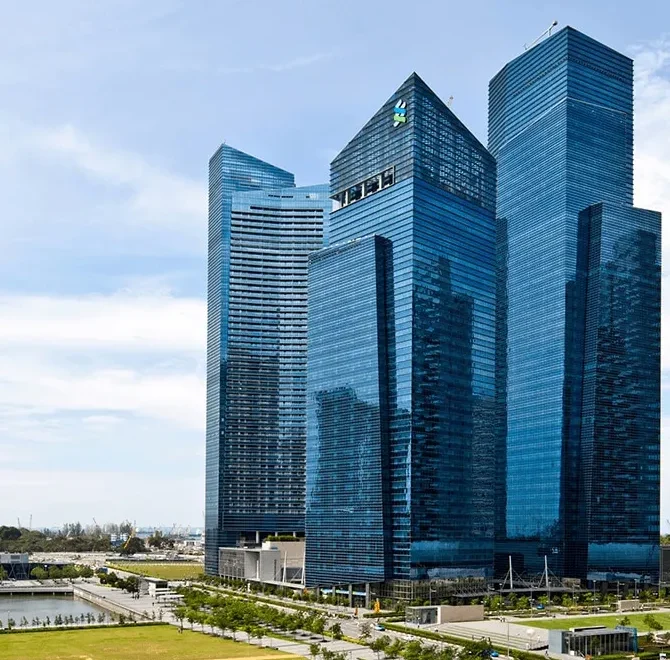
The Central Region’s rental index fell 0.1%, indicating that the market is still cautious. The biggest shift was the islandwide vacancy rate, which dropped from 11.4% at the end of the second quarter to 11.2% at the end of the third.
This simultaneous minor rental dip and fall in vacancy points to a “stock contraction” phenomenon. URA data confirmed that the overall stock of office space contracted by 24,000 square metres (sq m) of Net Lettable Area (NLA) in Q3, following an 18,000 sq m contraction in Q2. This shrinkage is largely attributed to ongoing redevelopment and asset enhancement initiatives (AEI), where older buildings are being pulled off the market for modernization or conversion. While the total occupied space still managed a slight increase of 1,000 sq m in NLA, the overall reduction in supply stock helped to push the vacancy rate lower. This suggests that the slight rental softness is likely due to cautious pricing in older or peripheral Central Region buildings, rather than a systemic drop in demand.
The Flight-to-Quality Remains Strong
The premium CBD Grade A industry is performing well, although the URA Central Region Index may not reflect this. The Central Region’s rental index fell 0.1%, indicating that the market remained cautious. The most significant change was the islandwide vacancy rate, which decreased from 11.4% in the second quarter to 11.2% at the end of the third quarter.
This divergence reinforces the “flight-to-quality” trend. Large corporate occupiers are aggressively shifting from older, less efficient buildings to newer, more premium, and ESG-compliant facilities. These movements create displacement demand—as older buildings are vacated for redevelopment, their tenants move into available newer stock, keeping prime occupancy levels high and rents firm. For landlords of older, Category 2 office buildings in the Central Region, the pressure to modernise or redevelop is intensifying. The slight dip in the general index suggests that tenants are wielding increasing bargaining power for non-premium space.
Supply Pipeline and Forward Outlook
How the market acts in the future will depend a lot on the supply stream. By the end of the third quarter of 2025, an office building with 870,000 square meters of space was to be built. This was a little higher than the previous quarter.
No new, considerable supply will enter the Core CBD for two years (2026–2027). Keppel South Central and IOI Central Boulevard Towers are two new projects, although few more are planned. High-end apartment rentals are expected to remain high for some time due in large part to this dearth of availability. According to economists, the tighter vacancy rate would eventually drive higher rents overall through 2026 and 2027 as the extra supply from 2024 to 2025 is fully absorbed.
The Q3 2025 data, therefore, paints a picture of a market in a short-term holding pattern. The marginal rental dip is less a sign of weakness and more a consequence of the current stock mix and a lingering cautious sentiment, counterbalanced by persistent, deep demand for the best-in-class assets and a low future supply runway.